The Melike Hatun Mosque in Ankara—a symbol of the new capital

The Melike Hatun Mosque: A New Landmark in Old Ankara

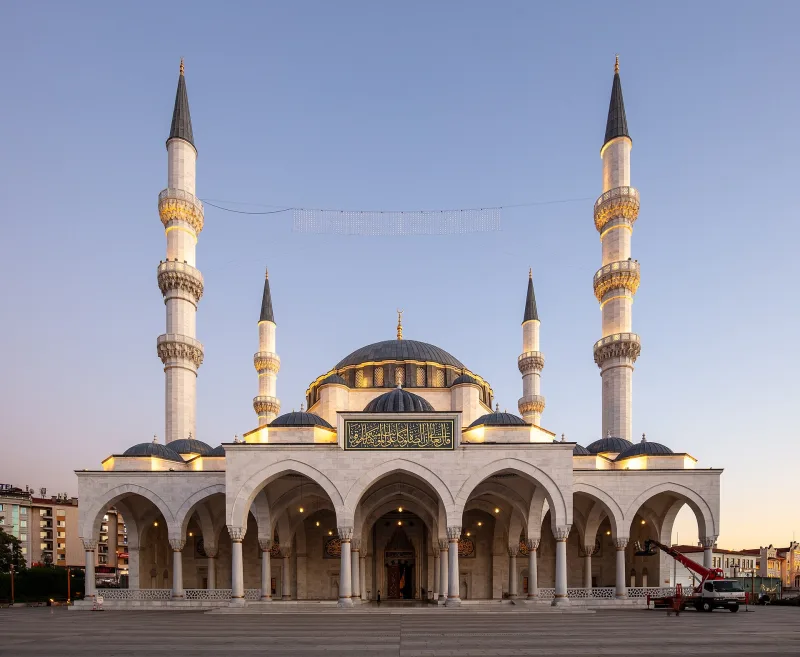
Imagine this: you are standing in the Ulus neighborhood—the oldest district of the Turkish capital, where once stood the center of Byzantium, then Angora, and later the young republican Ankara. Rising above the familiar city noise are four minarets, each 72 meters high. A dome with a diameter of 27 meters soars to a height of 47 meters—and this entire complex opened to worshippers quite recently: on September 27, 2017. The Melike Hatun Mosque is the most magnificent religious building in Ankara today, designed to accommodate 7,000 worshippers. Named after an influential 14th-century woman, the patroness of the city’s religious and social life, the Melike Hatun Mosque combines Seljuk, Ottoman, and modern architectural motifs—and has already become a new symbol of the capital, around which discussions about Ankara’s past and future are raging.

History and Origin of the Melike Hatun Mosque

The mosque’s name belongs to a real historical figure—Melike Hatun, a wealthy and influential resident of 14th-century Ankara. According to Professor Hüseyin Çınar of Yıldırım Beyazıt University, she was, in all likelihood, the daughter of Kaykubad III—the last of the Anatolian Seljuk sultans (who reigned from 1298 to 1302). There is no precise documentary evidence of this, but her real influence on the life of the city is confirmed: Melike Hatun commissioned numerous public buildings in Ankara and supported the Sufi thinker and poet Hacı Bayram-ı Veli, whose spiritual legacy remains deeply rooted in the religious culture of the region to this day. She should not be confused with the better-known Melike Mama Hatun, mentioned in other sources.

Construction of the modern mosque lasted four years and was completed in 2017. The project was designed by architect Hilmi Şenalp. The mosque was inaugurated on September 27, 2017, with Turkish President Recep Tayyip Erdoğan in attendance. In his speech, Erdoğan stated that the mosque would become a symbol for Ankara. He also touched on the topic of history: according to him, during the single-party period of the Turkish Republic, attempts were made to strip Ankara of its original identity, including by restricting the construction of religious sites. These remarks immediately sparked controversy: some experts and journalists viewed the construction of the mosque as a “neo-Ottoman move directed against republican urban planning.” The debate continues to this day, making the Melike Hatun Mosque not merely an architectural landmark but a unique barometer of Turkish socio-political life.

The mosque is located in Ankara’s old quarter, in an area locals call Hergele Meydanı, east of Atatürk Boulevard and Gençlik Parkı—the capital’s largest city park. The choice of location is no coincidence: Ulus is the historic heart of Ankara, and the construction of a large-scale religious building here carries a distinct symbolic message.

Architecture and What to See

The Melike Hatun Mosque is one of the most impressive religious structures in modern Ankara. Its architectural style is deliberately eclectic: Hilmi Şenalp combined Ottoman, Seljuk, and modern motifs in the design.

Silhouette: four minarets and the main dome

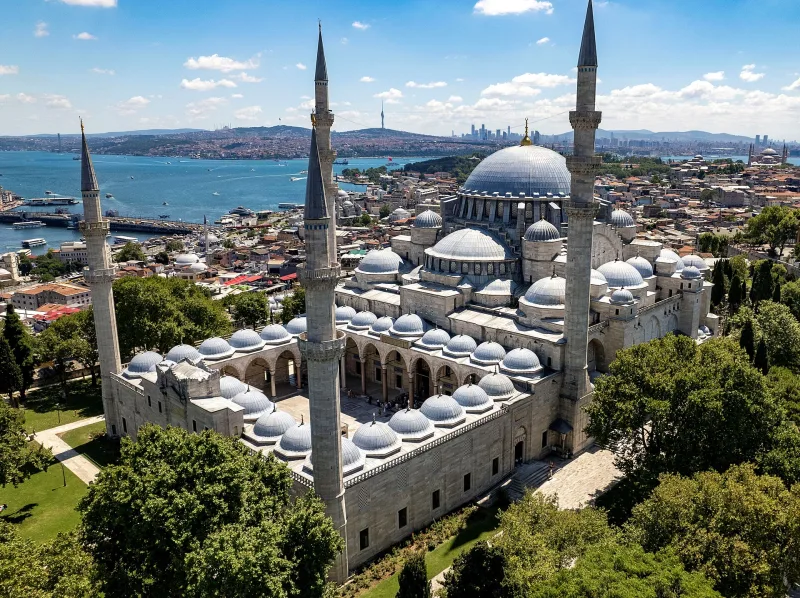
The four minarets, each 72 meters high and featuring three şerefe (balcony-galleries for the muezzin) on each, are positioned at the corners of the base and create a powerful vertical focal point. The main dome, with a diameter of 27 meters, reaches a maximum height of 47 meters. At the top of the dome is an alem—a metal finial—20 centimeters high. The layout with four minarets references Istanbul’s largest sultan’s mosques: the Blue Mosque (Sultan Ahmed Camii) and the Süleymaniye Mosque—and immediately establishes the building’s ambitious scale.

Inscriptions above the entrances and decoration

Decorative inscriptions using gold leaf, bone, mother-of-pearl, and ivory are arranged above the entrance portals—a technique dating back to the Seljuk and early Ottoman tradition of carved portal decoration. These handcrafted details stand in stark contrast to the building’s monumental scale and create a sense of a carefully calibrated balance between solemnity and delicate craftsmanship.

Prayer hall for 7,000 people

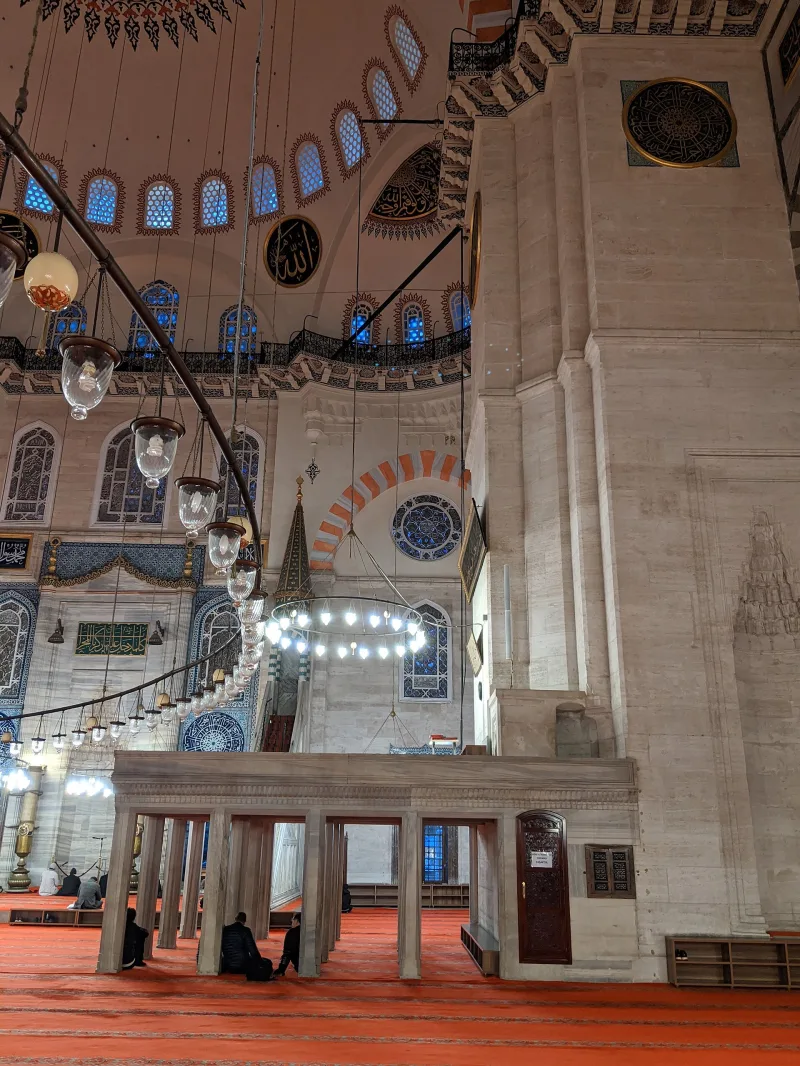
The mosque’s land area is 3,600 square meters. The prayer hall is designed to accommodate 7,000 worshippers at once. This makes the Melike Hatun Mosque one of the largest mosques in Ankara. The space beneath the dome follows a tradition rooted in the principles of Sinan’s mosques: a single, centrally focused volume with a high drum, ensuring excellent acoustics and a sense of sublime spaciousness.

Context and Exterior View

From the side of Gençlik Parkı and Atatürk Boulevard, the mosque reveals itself in all its grandeur. The city park and wide boulevard offer a rare opportunity to see the building in its entirety—without residential buildings in the foreground. This is the best spot for photography. Early in the morning or at sunset, the minaret towers glow particularly strikingly against the sky.

Interesting facts and legends

  • The mosque is named after a 14th-century woman—the alleged daughter of the last Seljuk sultan of Anatolia, a patron of the Sufi movement and the public works of Ankara.
  • Construction took four years, and the opening on September 27, 2017, took place in the presence of the country’s president and was accompanied by heated political debates about the role of Islam in the capital’s urban landscape.
  • Four 72-meter-high minarets make the mosque one of the tallest religious buildings in Ankara—it is visible from many points in the historic center.
  • Above the entrance portals are decorative inscriptions featuring gold leaf, mother-of-pearl, bone, and ivory: a rare example of the revival of medieval decorative techniques in modern architecture.
  • The mosque is located next to Gençlik Parkı—Ankara’s largest city park—creating an unusual contrast: a secular recreational park and a monumental mosque stand literally across the street from each other.

How to get there

The Melike Hatun Mosque is located in the Ulus district, in the old center of Ankara, east of Atatürk Boulevard and Gençlik Park. The nearest metro station is Ulus (Line M1); it takes about 10 minutes to walk from the station to the mosque. The metro ride from Kızılay to Ulus takes 5–7 minutes.

From Ankara Esenboğa Airport (ESB), take the Havaş bus to a stop in the city center (Kızılay or ASTI), then transfer to the metro to Ulus. A taxi ride from the airport takes about 40–50 minutes, depending on traffic. By bus: numerous EGO routes connect Ulus with other parts of the city. For those traveling on the Hızlı Tren from Istanbul or Eskişehir, the Ankara terminal station is located a few metro stops from Ulus.

Tips for travelers

The mosque is open daily, and admission is free. Follow the rules: remove your shoes at the entrance; women should wear a headscarf and modest clothing that covers the shoulders and knees. On Friday at noon (Jumu’ah), the mosque is crowded—it’s best to visit at another time if you’re looking for a peaceful visit.

Combine your visit with a walk through Gençlik Parkı: the park is literally right across the street. From there, all four minarets are clearly visible—an excellent spot for a panoramic photo. Nearby are also the Ankara Citadel, the Ethnographic Museum, and Hacı Bayram Camii—a mosque associated with the spiritual patron of Melike Hatun herself. In a single day in Ulus, you can explore several historical eras at once: Roman, Seljuk, and Republican.

The best time to visit is on weekday mornings or during holiday prayers (Ramadan, Eid al-Adha)—when the atmosphere is particularly solemn. Sunset is ideal for photography: the minarets are bathed in gold, and the dome glows against the backdrop of a dark blue sky. The Melike Hatun Mosque is a place you simply cannot miss when visiting Ankara: here, 14th-century history meets 21st-century architecture, and religion meets politics.
Your comfort is important to us, click on the desired marker to create a route.
Meeting for minutes before
Yesterday. 17:48
Frequently asked questions — The Melike Hatun Mosque in Ankara—a symbol of the new capital Answers to frequently asked questions about The Melike Hatun Mosque in Ankara—a symbol of the new capital. Information about the service's operation, capabilities, and use.
Melike Hatun was a real historical figure from the 14th century, a wealthy and influential resident of Ankara. According to Professor Hüseyin Çınar of Yıldırım Beyazıt University, she was believed to be the daughter of Kaykubad III, the last sultan of the Anatolian Seljuks. She commissioned public buildings and supported the Sufi poet Hacı Bayram-ı Veli. The mosque was named after her as a tribute to this patron of the city’s religious and social life. It is important not to confuse her with Melike Mama Hatun, who is mentioned in other historical sources.
Construction of the mosque took four years. The opening ceremony took place on September 27, 2017, in the presence of Turkish President Recep Tayyip Erdoğan. The design was created by architect Hilmi Şenalp. Thus, the Melike Hatun Mosque is a relatively new structure, despite its deeply historical architectural style.
At the opening ceremony, President Erdoğan stated that during the single-party era of the Republic of Turkey, attempts were made to strip Ankara of its traditional identity, including through restrictions on the construction of religious buildings. Some experts and journalists viewed the construction of the mosque in the historic center as a “neo-Ottoman move against republican urban planning.” The debate continues, and the mosque is perceived not only as an architectural symbol but also as a political one.
The mosque’s prayer hall can accommodate 7,000 worshippers at a time. This makes the Melike Hatun Mosque one of the largest mosques in Ankara. The land area is 3,600 square meters. The space under the dome is organized according to a principle that traces back to the tradition of the great architect Sinan’s mosques: a single, centrally focused space with a high drum, ensuring excellent acoustics.
No, admission to the Melike Hatun Mosque is free. The mosque is open daily to everyone. The only requirement is that visitors follow the rules of conduct for a religious institution: remove your shoes at the entrance, and women should wear a headscarf and clothing that covers their shoulders and knees.
Yes, the mosque is open to all visitors regardless of their religious beliefs. The only important thing is to follow the general rules: remove your shoes before entering, behave quietly and respectfully, and for women, cover your head and wear modest clothing. On Friday at noon (Jumu’ah prayer), the mosque is usually crowded—it’s best to postpone your sightseeing at this time.
The Melike Hatun Mosque stands out for several distinctive features. Four minarets, each 72 meters high—a design reminiscent of Istanbul’s largest sultan’s mosques: the Blue Mosque (Sultan Ahmed Camii) and the Süleymaniye Mosque. The main dome, with a diameter of 27 meters, rises to a height of 47 meters. Above the entrance portals are decorative inscriptions featuring gold leaf, mother-of-pearl, bone, and ivory: a rare revival of medieval handcrafted techniques in modern architecture. The architectural style is deliberately eclectic, blending Seljuk, Ottoman, and contemporary motifs.
Four minarets represent a historically privileged design typical of the largest sultan’s mosques in the Ottoman Empire. Mosques with four minarets were built as a symbol of state and religious grandeur. Hilmi Şenalp deliberately adopted this design to emphasize the building’s scale and status. Each minaret features three şerefe—balcony galleries for the muezzin—which also follows the tradition of large imperial mosques.
The mosque is located in the Ulus district—the historic heart of Ankara. Just across the street is Gençlik Parkı, the capital’s largest city park, which offers the best panoramic view of all four minarets. Nearby are the Ankara Citadel, the Ethnographic Museum, and Hacı Bayram Camii—a mosque associated with the spiritual patron of Melike Hatun herself. In a single day in Ulus, you can truly experience several historical eras: Roman, Seljuk, and Republican.
A tour of the mosque, both inside and out—including a walk around the surrounding area and taking photos—usually takes about 90 minutes. If you plan to combine your visit with a walk through Gençlik Parkı and nearby sites—such as Hacı Bayram Mosque or Ankara Castle—allow half a day.
The best time to visit is in the spring and fall, when the weather in Ankara is pleasant for walking through the historic center. In the summer, the city center can get very hot, and in the winter, it can be windy and cold. Sunset is the perfect time for photography: the minarets are bathed in golden light, and the dome contrasts beautifully with the dark blue sky. The atmosphere is particularly solemn during the days of the festive prayers—Ramadan and Eid al-Adha.
From Ankara Esenboğa Airport (ESB), the most convenient way is to take the Havaş bus to the Kızılay or ASTI stop in the city center, then transfer to the M1 metro line to Ulus Station—the closest stop to the mosque (about a 10-minute walk). A taxi ride from the airport to Ulus takes about 40–50 minutes, depending on traffic. If you’re arriving by Hızlı Tren from Istanbul or Eskişehir, it’s just a few stops on the metro from Ankara’s main train station to Ulus station.
User manual — The Melike Hatun Mosque in Ankara—a symbol of the new capital The Melike Hatun Mosque in Ankara—a symbol of the new capital User Guide with a description of the main functions, features, and principles of use.
Plan your visit for a weekday, avoiding Friday around noon—that’s when Jumu’ah prayers are held and the mosque is packed. For a peaceful visit, mornings from Monday through Thursday are best. If you want to experience a special atmosphere, come during Ramadan or Eid al-Adha. For photography, aim for sunset hours. Spring and fall are the most comfortable seasons for strolling through historic Ulus.
Take the M1 metro line and get off at Ulus Station—this is the closest station to the mosque, and it’s about a 10-minute walk from there. From central Kızılay, the trip takes 5–7 minutes by metro. If you’re taking the bus, numerous EGO routes connect Ulus with other parts of the city. The mosque is located east of Atatürk Boulevard and Gençlik Park—the main landmarks of the area.
Before entering, walk around the mosque from the outside. The best view is from Gençlik Parkı: the spacious city park and Atatürk Boulevard offer a rare opportunity to see the entire building in its entirety, without residential buildings in the foreground. From here, you can clearly see all four 72-meter-high minarets and the main dome. At sunset, the minarets glow particularly beautifully—this is the best time to take a panoramic photo.
At the entrance to the mosque, please remove your shoes and leave them on the designated shelf or carry them with you in a bag. Women must cover their heads with a scarf and wear clothing that covers their shoulders and knees—scarves are sometimes available at the entrance, but it’s best to bring your own. Admission is free at any time except during prayer times, when visits by tourists are restricted. Please remain quiet and do not disturb those who are praying.
Once inside, take a moment to admire the space beneath the dome: it has a diameter of 27 meters and a height of 47 meters. The single, centrally focused space creates a sense of soaring openness and provides excellent acoustics. Take a look at the decorative inscriptions above the entrance portals: they are crafted using gold leaf, mother-of-pearl, bone, and ivory—a rare revival of medieval hand-decoration techniques. The hall can accommodate 7,000 people, but on a weekday it is nearly empty, allowing you to take your time exploring everything.
After touring the mosque, head to Gençlik Parkı—it’s literally just across the street and offers a great view of the minarets from a different angle. Next, be sure to visit Hacı Bayram Camii—a mosque associated with the spiritual patron Melike Hatun—and the Ankara Citadel, which offers a panoramic view of the entire historic center. The Ethnographic Museum is also nearby. In a single day in Ulus, you can explore several historical eras: from Roman antiquity to the Seljuk and Republican periods.